

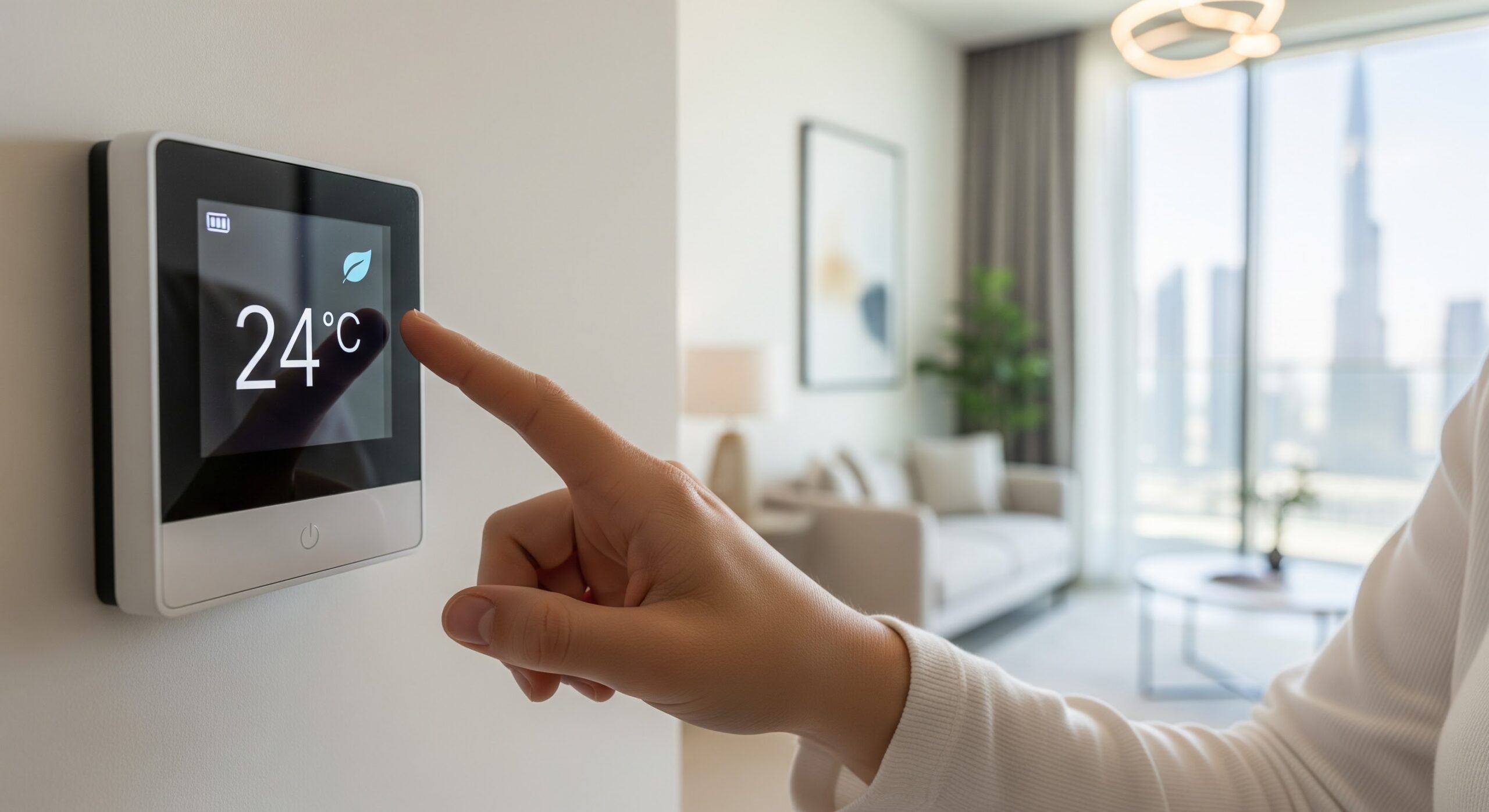
AC accounts for up to 70% of your DEWA bill during peak summer months. The good news: a handful of targeted changes can push you into a cheaper tariff band entirely, without sacrificing comfort.
QUICK WINS AT A GLANCE
- Set your thermostat to 24°C (each degree lower adds roughly 5% to your bill)
- Clean AC filters every 4 weeks in summer
- Seal west- and south-facing windows with blackout curtains or reflective film
- Run a ceiling fan alongside your AC to raise the thermostat 2°C without noticing
- If your unit is over 10 years old, an inverter replacement pays for itself in 2 to 3 summers
If your DEWA bill spikes every summer, your air conditioner is almost certainly the reason. AC accounts for up to 70% of a Dubai home’s electricity consumption during peak months. Because DEWA uses a tiered slab tariff, the more you consume, the higher the rate you pay per kilowatt-hour. That means a relatively small reduction in AC usage does not just save proportional energy costs. It can drop you into a cheaper billing band entirely, multiplying your savings.
The steps below follow DEWA’s own published cooling recommendations and are ordered by impact. None of them require turning your home into a sauna.
1. Understand how DEWA’s tariff slabs work
Before adjusting any settings, it helps to understand why the savings compound. DEWA charges residential customers on a tiered consumption model. You pay a lower rate per kWh for the first band of usage, and progressively higher rates as your monthly consumption climbs.
If your summer usage is pushing you into a higher band, even a 15 to 20% reduction in AC usage could push you back into a cheaper tier. The saving is therefore greater than the raw kWh reduction would suggest. Check your current slab position using DEWA’s tariff calculator and monitor live consumption through the DEWA Smart Living dashboard
2. Set your thermostat to 24°C, and no lower
DEWA officially recommends 24°C as the optimal comfort and efficiency setting. Setting your AC to 20°C does not cool your home faster. It simply forces the compressor to run for much longer, burning considerably more electricity for a marginal comfort difference.
Auto mode: Use Auto mode on your AC and set the temperature to 24°C. The system will automatically turn the compressor on when the room warms above 24°C and switch it off once the set temperature is reached again, helping maintain comfort while reducing unnecessary energy use overnight.
Do not switch AC off entirely when travelling. In summers, a fully closed-off home can develop mould and moisture damage within days. If you are away for more than a few hours, set the thermostat to 25 to 26°C rather than switching the unit off.
3. Keep your AC properly maintained
A poorly maintained unit works harder to deliver the same cooling, burning more electricity in the process. These four maintenance tasks have the biggest measurable impact on your DEWA bill:
| Task | Frequency | Bill impact |
|---|---|---|
| Filter cleaning | Every 4 weeks in summer | Up to 15% efficiency loss if clogged |
| Evaporator and condenser coil cleaning | Annually at minimum | Dirty coils extend compressor cycles by 20 to 30% |
| AC duct inspection and cleaning | Every 2 years | Leaky ducts waste 20 to 30% of cooled air |
| Refrigerant level check | Annual AC service | Low refrigerant forces far longer run cycles |
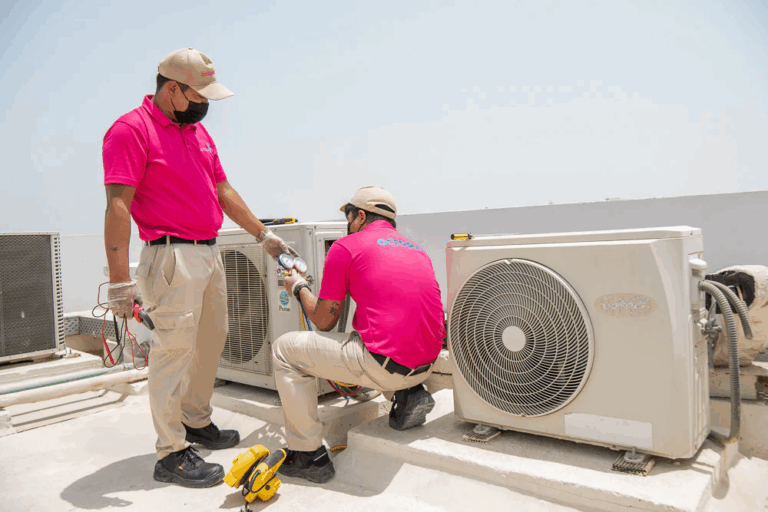
Of these, AC duct cleaning is the most commonly overlooked. If your system shows any of these signs, scheduling an AC repair before summer is the most cost-effective fix. If your ducts have not been professionally cleaned in two or more years, that is the first call to make.
4. Stop heat entering your home
The less heat your home absorbs through its envelope, the less work your AC compressor has to do. In Dubai homes, the largest heat sources are west- and south-facing windows during afternoon hours, and sliding balcony doors with worn rubber seals. These passive measures can reduce your cooling load by 10 to 15% without touching the thermostat.
For apartments
Fit blackout or reflective curtains on sun-facing windows. Reflective window film is an even more effective option and can usually be installed without landlord permission, as it is a removable modification. A quality reflective film can reduce solar heat gain through west-facing windows by 40 to 70%.
For villas
Seal gaps around door frames with self-adhesive weather stripping, and check that balcony sliding doors close flush against their tracks. A gap of just a few millimetres is enough to pull hot, humid outdoor air into the cooled space continuously.
5. Use ceiling fans to raise the thermostat without noticing
A ceiling fan does not cool the air. It creates a wind-chill effect on your skin that makes 26°C feel like approximately 23°C. Running a fan alongside your AC lets you raise the thermostat by 2°C with no noticeable drop in comfort. That 2-degree adjustment alone reduces AC energy consumption by around 10%.
One important detail: fans only help when someone is present to feel the breeze. Switch fans off when leaving a room. Unlike your AC, a running fan in an empty room delivers zero cooling benefit and only adds to your bill.
6. When to upgrade your AC unit
If your unit predates inverter compressor technology, carries a low ESMA energy rating, or is more than 10 years old, it carries a significant efficiency penalty regardless of how well it is maintained. A professional AC installation with a modern ESMA 4-star or 5-star rated inverter unit can reduce cooling costs by 25 to 35%.
| Unit type | How it works | Running cost vs inverter |
|---|---|---|
| Fixed-speed compressor | Cycles fully on and off to maintain temperature | 40 to 50% more expensive per day |
| Inverter compressor (modern) | Adjusts speed continuously to hold temperature | Baseline |
The upfront cost of a quality inverter split unit is typically recovered within two to three summer billing cycles through DEWA savings. When comparing units, check the ESMA energy efficiency label. A 4-star or 5-star rated unit will deliver the best payback period in the summer conditions.
Frequently asked questions
What temperature should I set my AC to in summer in Dubai?
DEWA officially recommends 24°C as the optimal setting. This balances comfort against energy use. Every degree below 24°C increases your compressor run time and adds roughly 5% to your electricity consumption. During the night, using sleep mode to drift toward 25 to 26°C is comfortable for most people and meaningfully reduces overnight consumption.
Should I leave my AC on all day or switch it off when I go out?
For short absences of a few hours, raising the thermostat to 27°C uses less energy than allowing the home to heat up completely and then re-cooling it. For longer absences, set the unit to 27 to 28°C rather than switching it off. In summers, a fully switched-off home can develop humidity damage and mould within days, and the energy cost of re-cooling from 45°C can spike your bill sharply.
How often should AC be serviced in Dubai?
Filters should be cleaned every 4 weeks during summer and every 6 to 8 weeks in cooler months. A full professional service covering coil cleaning, refrigerant check, and duct inspection should be done at least once a year. Ideally, schedule this before summer begins, around March or April, so the unit is running at peak efficiency when cooling demand peaks.
Can smart thermostats really lower my DEWA bill?
Yes, for most households. Smart thermostats learn occupancy patterns and avoid cooling empty rooms to comfort temperatures. They also prevent the common habit of setting the AC very cold when arriving home and forgetting to adjust it. Savings of 10 to 15% in AC usage have been documented in Dubai pilot programmes. The payback period on a quality smart thermostat is typically one to two summers.
Does DEWA charge more per unit as I use more electricity?
Yes. DEWA uses a tiered slab tariff for residential customers. You pay a lower rate per kWh for the first band of consumption, and progressively higher rates as usage increases. This means reducing your summer AC usage does not just save the cost of the kilowatt-hours removed. If it drops you into a lower tariff band, every unit consumed that month becomes cheaper. Check your slab position via the DEWA app or website.
What is the difference between split AC, ducted AC, and district cooling?
Split AC units are single-room systems with an indoor fan coil and an outdoor compressor. Ducted AC uses a larger compressor to cool an entire apartment or villa through ceiling ducts. District cooling, provided by companies such as Empower and Al Tabreed, supplies chilled water from a central plant through the building’s infrastructure. If your building uses district cooling, your efficiency measures focus on the air handling unit inside your home rather than a compressor.
Is it worth buying an inverter AC to replace a fixed-speed unit?
In most cases, yes, if the fixed-speed unit is more than 10 years old. A modern ESMA 4-star or 5-star inverter unit running through a Dubai summer typically costs 40 to 50% less to operate per day than an equivalent fixed-speed model. For a typical 2-bedroom apartment running AC for 16 to 18 hours per day in summer, the savings are usually large enough to recover the cost of the new unit within two to three billing seasons.
Does window film work in Dubai apartments?
Yes. Window film is a thin polyester layer applied directly to glass that reflects solar radiation before it enters the room. In Dubai, west- and south-facing windows can receive direct afternoon sun for 4 to 6 hours during summer months. A quality reflective film can reduce solar heat gain through those windows by 40 to 70%. Most rental agreements permit it as a removable modification, and it does not require planning permission.
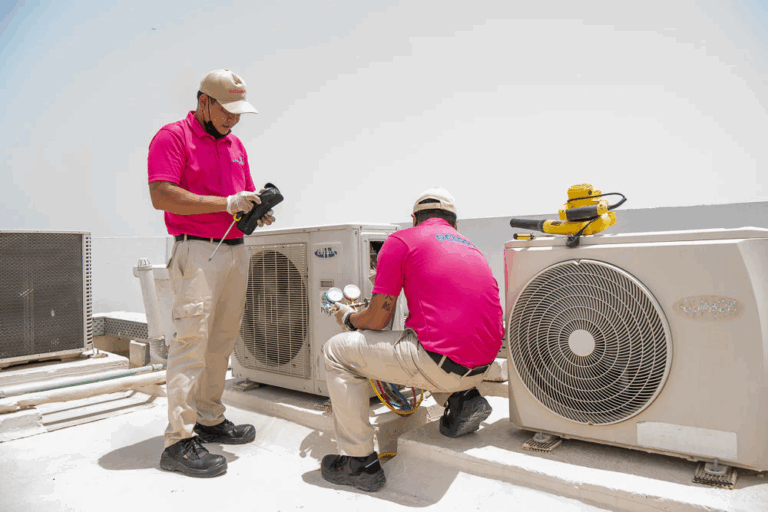
To keep your system running efficiently year-round, consider an annual maintenance contract in Dubai.




 AC Maintenance & Repair
 AC Replacement / Installation
 AC Duct Cleaning
 AC Coil Cleaning
 Annual Maintenance Contracts
 Water Tank Cleaning
 Plumbing
 Electrical
 Handyman
 Home Renovation